


The most common question in a Gynaecological Cancer OPD is, “ I have abnormal vaginal bleeding; is there anything to worry about ?”
It’s a question many women ask quietly. Sometimes they’ve ignored the symptom for weeks, hoping it would stop on its own. Others think it’s simply part of menopause, an infection, or hormonal changes. Often the first thing that comes to their mind is “ଏହା କ’ଣ ଯୋନି କର୍କଟ ରୋଗ? (Is it vaginal cancer?)”
Vaginal cancer is a type of cancer that affects the vaginal tissue. The vagina is the muscular tube that connects the uterus to the outside of the body, and vaginal cancer occurs when abnormal cells grow uncontrollably in the lining of the vagina.
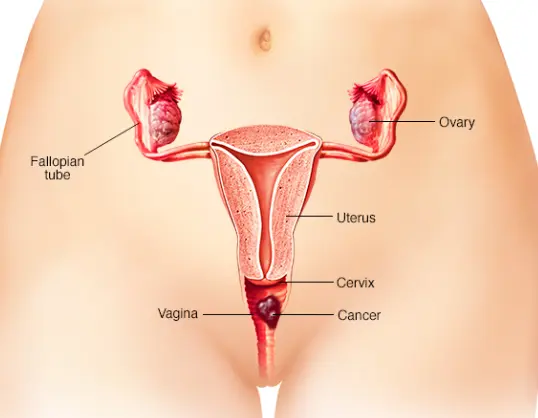
The truth is, most of these symptoms are not caused by vaginal cancer.
But they also shouldn’t be ignored.
As a gynecologic oncosurgeon, I often tell my patients that our job isn’t to assume every symptom is cancer. Our job is to understand why it’s happening.
Let’s talk about the early signs of vaginal cancer, what they mean, and when it’s time to see a doctor.
Does Vaginal Cancer Cause Symptoms Early?
One of the challenges with vaginal cancer is that it often doesn’t show early symptoms.
In its earliest stage, many women feel completely well. There may be no pain, no lump, and no obvious warning sign, only slight watery discharge or staining of the underwear, which many of us disregard as “normal”.
Many a time, vaginal cancer is found during evaluation for abnormal vaginal bleeding, but by then it is increased in size. That’s one reason early check-ups remain so important.
When any symptom persists, it should not be mistaken for common conditions such as a vaginal infection, menopause, or irritation before a proper evaluation.
What Are The Most Common Early Signs of Vaginal Cancer
Let’s look at the symptoms that deserve attention.
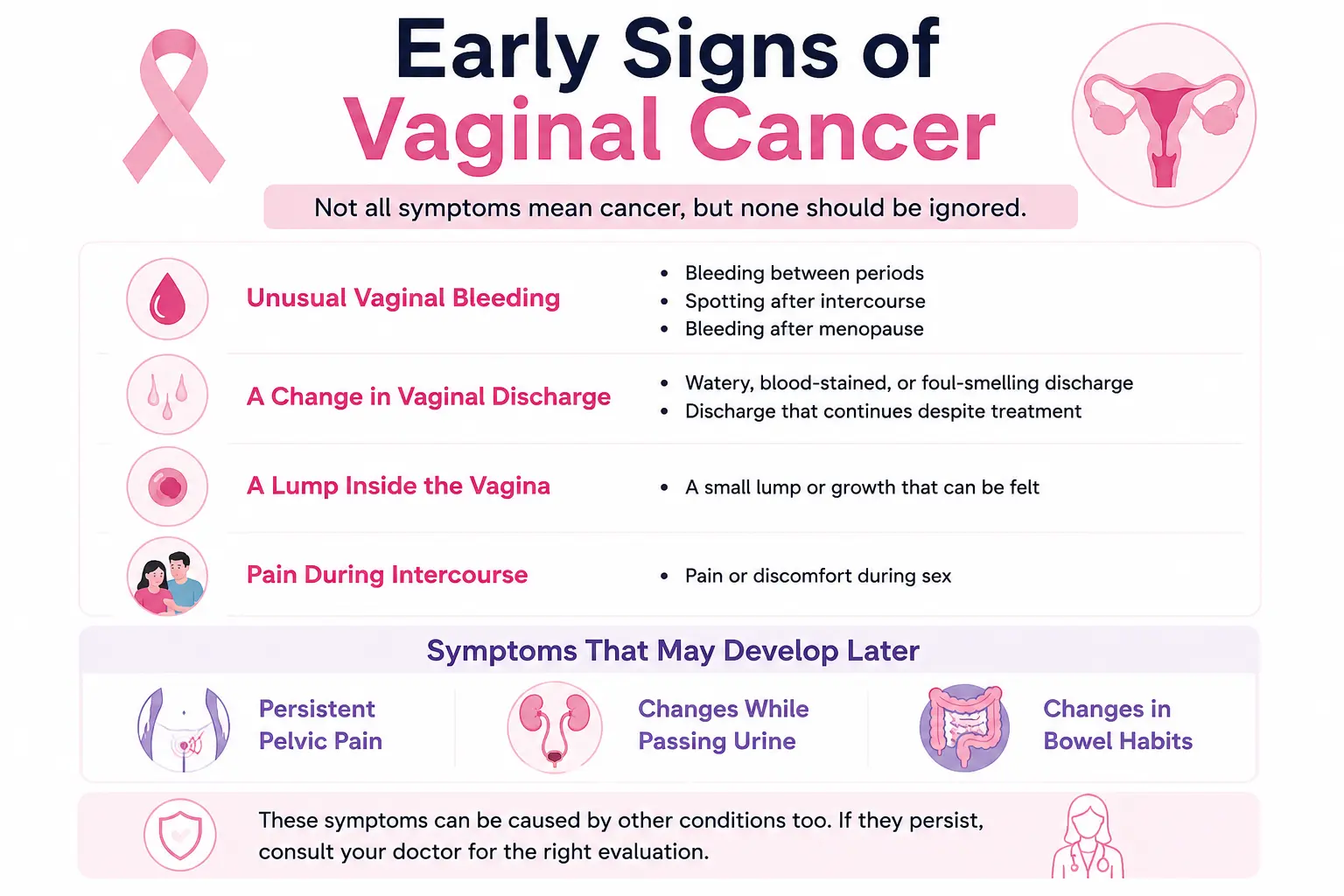
Unusual Vaginal Bleeding
This is the most common early symptom of vaginal cancer.
Women may notice:
- Bleeding between periods
- Spotting after sexual intercourse
- Bleeding after menopause
- Bleeding that isn’t part of their normal menstrual cycle
Many women assume this is due to stress or hormonal changes.
Sometimes it is.
But any unexplained bleeding, especially after menopause, should always be evaluated.
A Change in Vaginal Discharge
Every woman has some vaginal discharge.
What concerns me is when the discharge suddenly becomes different.
You may notice:
- A watery discharge
- Blood-stained discharge
- A foul-smelling discharge
- A discharge that continues despite treatment
This doesn’t automatically mean cancer.
Infections are still a much more common cause.
But if the discharge keeps returning or doesn’t improve with treatment, it warrants a closer look.
A Lump Inside the Vagina
Some women notice a small lump while bathing or inserting a tampon.
Others never feel it themselves. It is found during a pelvic examination.
Not every vaginal lump is cancer.
It could be a cyst, scar tissue, or another benign condition.
But any new lump should be examined rather than ignored.
Symptoms That May Develop Later
If vaginal cancer grows beyond its earliest stage, it can begin affecting nearby organs.
Symptoms may include:
Persistent pelvic pain
A dull ache, pressure, or discomfort that doesn’t go away.
Changes while passing urine
You may notice:
- Pain during urination
- Passing urine more often
- Blood in the urine
Changes in bowel habits
Some women experience:
- Constipation
- Pain during bowel movements
- A feeling of pressure in the rectum
These are not specific to vaginal cancer. Many non-cancerous conditions can cause similar problems. The important point is persistence.
When symptoms continue for several weeks without an obvious explanation, they deserve medical evaluation.
Why Are These Symptoms Often Missed?
This is something I discuss with patients quite often.
Most of the vaginal cancer symptoms overlap with much more common conditions.
Because these everyday conditions are so common, women often treat themselves at home or wait for symptoms to settle. Sometimes they do. Sometimes they don’t. That’s why I encourage women not to focus on the symptom alone. Instead, pay attention to how long it lasts. Along with these, if you have unexplained weight loss, significantly reduced appetite and energy to do daily activities, then there is definitely something to investigate further.
How Do We Find the Cause?
The first step is usually a detailed discussion about your symptoms followed by clinical examination and a biopsy if required.
A biopsy sounds frightening, but it simply means taking a very small tissue sample to reach a definite diagnosis. It answers questions that no scan or blood test can answer with certainty.
Does Having These Symptoms Mean You Have Cancer?
No.
This is probably the most important message I’d like you to take away.
Most women with abnormal bleeding or unusual discharge have conditions that are not cancer.
It may be:
- A vaginal infection
- Hormonal changes
- Cervical polyps
- Vaginal dryness after menopause
- Benign growths
The purpose of seeing your doctor is not because cancer is the most likely diagnosis.
It’s because cancer is one possibility that should never be overlooked.
Finding it early makes treatment much more effective.
A Final Thought
Your body often gives small signals before it gives big ones.
Don’t ignore them.
If something feels different and doesn’t return to normal, let someone examine it.
You don’t need to diagnose yourself.
You don’t need to assume the worst.
You simply need to ask the question.
Sometimes the answer is reassuring.
And if something more serious is found, finding it early gives us the best chance of treating it successfully.
Frequently Asked Questions
The early signs of vaginal cancer may include abnormal vaginal bleeding, watery or blood-stained discharge, and a lump inside the vagina. Some women have no symptoms at all in the early stages.
No. Vaginal cancer is a rare gynecologic cancer, accounting for about 1-2% of all female genital cancers.
Many women who have vaginal cancer do not have any risk factors, and having 1 or 2 risk factors does not mean you will get it. Knowledge about risk factors helps us clinicians to screen and educate patients, but it should never be used to self-analyse or self-diagnose your symptoms.
Yes — roughly three-quarters of vaginal cancers are linked to HPV infection, particularly HPV 16 and 18. The HPV vaccine, most effective when given before sexual activity begins, reduces this risk significantly. It’s worth discussing with your doctor, regardless of age, as catch-up vaccination is available for many adults as well.
If you’re in or around Bhubaneswar and have any of the symptoms above, you can consult me at Bagchi Sri Shankara Cancer Centre and Research Institute. You can also reach me at 9701029846 to book an appointment.