


There is no straight answer to the question. The answer is, “It depends.”
The word “cyst” sounds worrying. It becomes even more frightening when you start reading about ovarian cancer online. Before long, every episode of abdominal pain and every Google search seems to point in the same direction.
In the vast majority of women, an ovarian cyst is a normal physiology, meaning it is not cancer and it does not turn into cancer over time. The confusion happens because some ovarian cancers can appear cyst-like on scans, but that doesn’t mean a simple cyst becomes cancer.
Let’s understand the difference.
What exactly is an ovarian cyst?
Your ovaries are busy organs.
Every month, one of them prepares an egg for ovulation. During this normal process, a small fluid-filled sac develops. Sometimes that sac doesn’t disappear as expected and becomes what we call an ovarian cyst.
In other words, many ovarian cysts are simply part of the normal menstrual cycle, and they get detected when we do ultrasound scanning for some other purpose like irregular periods, pelvic pain, infertility, or even a routine health check-up. With the rise of obesity, a common finding in scans is PCOD, meaning multiple small cysts in the ovary of young girls.
So, can ovarian cysts cause cancer?
This is where I want to clear up one of the biggest myths.
A simple ovarian cyst does not slowly change into ovarian cancer.
Think about a water balloon. If you leave a water balloon in your room, it may shrink, burst, or dry out over time. But it doesn’t suddenly become a rock. A simple ovarian cyst behaves similarly. It may disappear on its own. It may stay the same. Occasionally, it may grow larger. But it usually doesn’t transform into cancer.
The real challenge is that some ovarian cancers can look like cysts on an ultrasound, especially in the early stages, and some cysts, like chocolate cysts, can rarely turn into cancer. That’s why your doctor doesn’t stop at simply reading the word “cyst” in the report. We look carefully at what kind of cyst it is.
Why Screening Matters So Much
I’ll be honest with you. Most women I see with advanced cervical cancer haven’t had regular screenings. They either never got tested or it had been years since their last check-up.
This breaks my heart because cervical cancer is highly treatable when caught early.
Regular cervical cancer screening does two important things:
It finds problems before they become cancer. Screening tests can spot abnormal cells early. We can treat these cells before they turn cancerous. This is prevention at its most valid.
It catches cancer at an early stage. When cervical cancer is detected early, treatment is much more effective. Survival rates are excellent. Quality of life remains good.
Think of screening like maintaining your car. Regular check-ups catch minor issues before they become expensive problems. Your health deserves the same attention.
Are all ovarian cysts the same?
This is something every woman should know.
When I review an ultrasound, I don’t just ask, “Is there a cyst?”
I ask,
“What kind of cyst is this?”
That answer makes all the difference.
A simple cyst is filled only with clear fluid. It has thin walls and a smooth appearance. These are usually harmless and often disappear within a few months without treatment.
A complex cyst looks different. It may contain thick walls, internal partitions, solid areas, or blood flow within the mass.
A complex cyst is not automatically cancer, but it deserves a closer evaluation because it carries a higher chance of needing treatment than a simple cyst.
When should we be more careful in the case of an ovarian cyst?
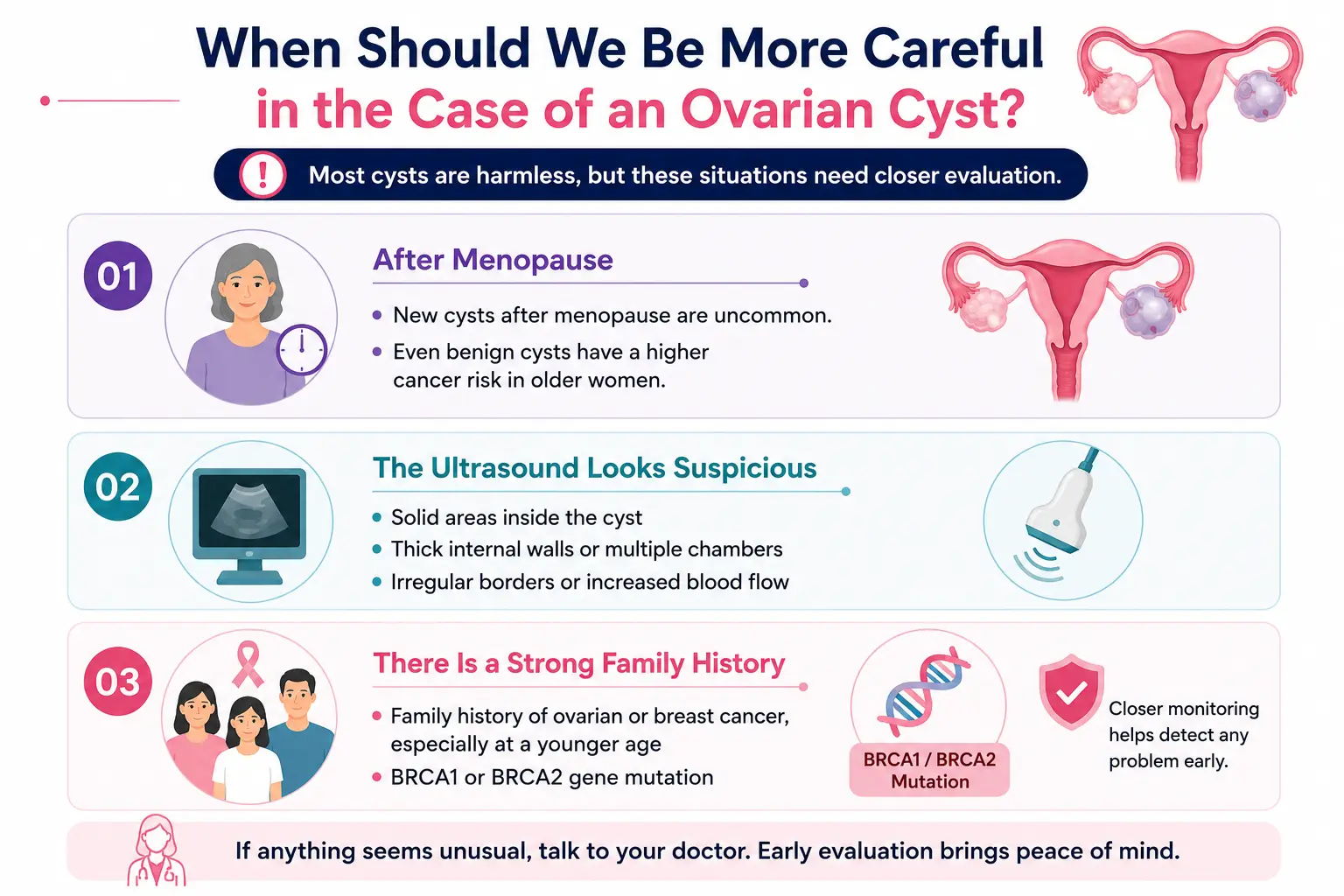
Although most cysts are harmless, there are situations where I recommend a more detailed evaluation.
After Menopause
New ovarian cysts are much less common after menopause because the ovaries are no longer releasing eggs every month.
So when a new cyst appears after menopause, we investigate it more carefully.
The Ultrasound Looks Suspicious
Sometimes the ultrasound itself gives us clues.
Features that need closer attention include:
- Solid areas inside the cyst
- Thick internal walls
- Multiple chambers
- Irregular borders
- Increased blood flow
These findings don’t confirm cancer, but they tell us that more tests are needed.
There Is a Strong Family History
If close family members have had ovarian cancer or breast cancer, especially at a younger age, your overall risk is naturally higher.
Women with BRCA1 or BRCA2 gene mutations also need closer monitoring because these inherited mutations increase the lifetime risk of ovarian cancer.
How do we know whether it's safe even though you have an ovarian cyst?
Fortunately, we don’t have to guess.
We have several tools that help us decide whether a cyst simply needs observation or requires further evaluation.
Transvaginal Ultrasound or MRI
They tell us the size, shape, and internal structure of the cyst.
Very often, the ultrasound or MRI provide enough reassurance that the cyst is harmless.
Repeat Ultrasound
For younger women with a simple cyst, the safest treatment is often… patience.
Instead of rushing into surgery, we repeat the ultrasound after 6 to 8 weeks after menstruation.
Many cysts disappear naturally during this time.
Sometimes, doing less is actually the right treatment.
Blood Test
You may have heard about the CA-125 test.
Many people believe it is a “cancer test.”
It’s actually not that simple.
CA-125 can increase in ovarian cancer, but it can also rise because of endometriosis, fibroids, menstruation, pelvic infections, and several non-cancerous conditions. Along with that, we have many other markers to help us decide the probable nature of the cyst.
That’s why we never diagnose ovarian cancer based on one blood test alone. We interpret it along with the ultrasound findings and your clinical history.
What symptoms shouldn't be ignored if you have an ovarian cyst?
Most ovarian cysts don’t have any symptoms.
However, whether it’s a large cyst or, rarely, an early ovarian cancer, certain symptoms deserve medical attention if they continue for more than a few weeks.
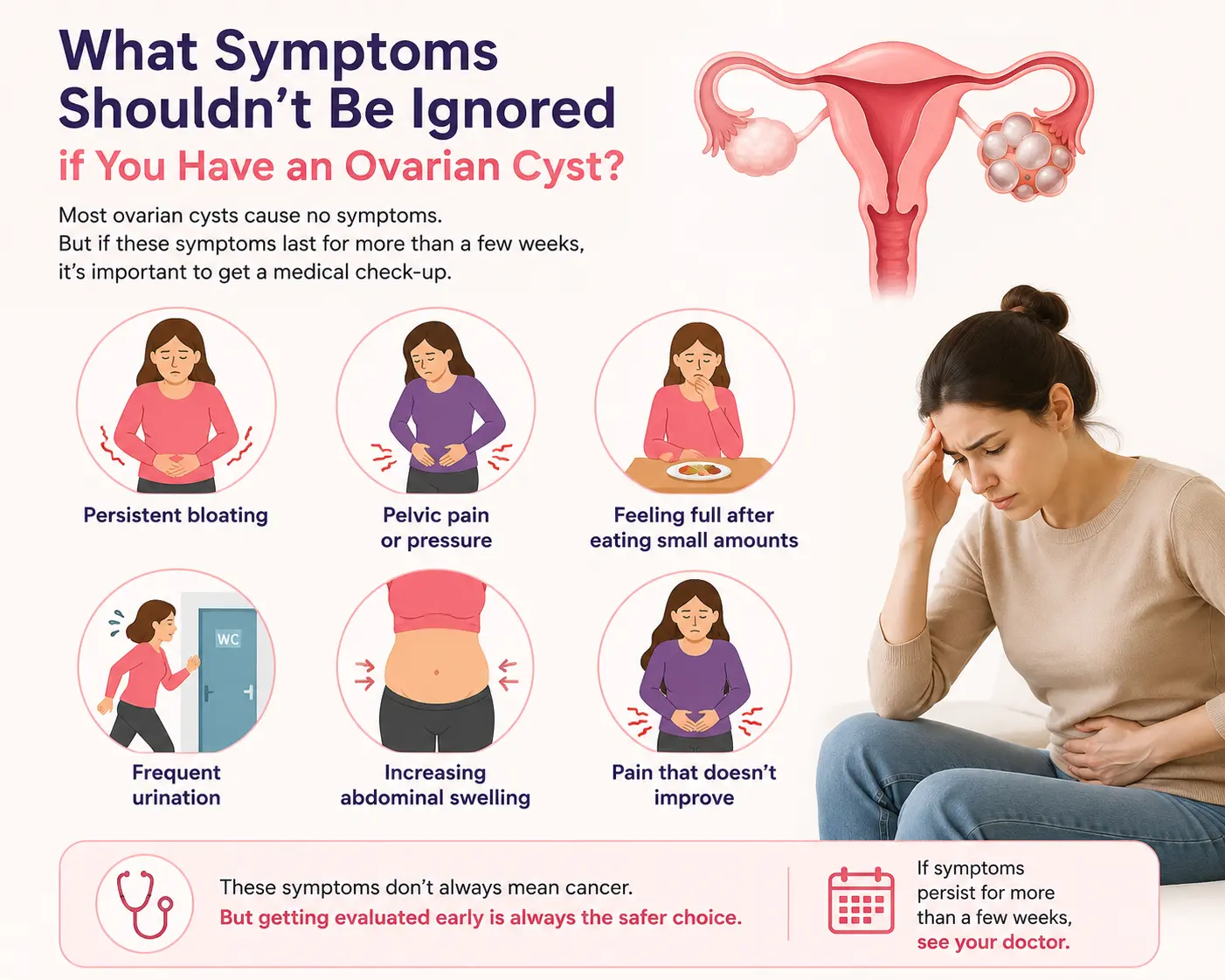
These symptoms don’t automatically mean cancer.
They simply mean your body is asking for a proper evaluation.
Does every ovarian cyst need surgery?
No. In fact, most women never need surgery.
If the cyst is small, simple, and you’re still having regular periods, observation is often the safest approach.
Surgery is usually considered when:
- The cyst is very large.
- It keeps growing.
- It causes severe pain.
- It looks suspicious on imaging.
- There is concern that it may not be benign.
The goal is always to avoid unnecessary surgery while ensuring we don’t miss anything important.
My advice to every woman
If you’ve recently been told you have an ovarian cyst, don’t let the word itself frighten you.
Instead, ask a better question.
“What type of cyst do I have?”
Most ovarian cysts are simply a part of life. Many disappear without treatment. Some need monitoring. Only a small number require surgery or further investigation.
The important thing is not to ignore the report, but also not to assume the worst. The right diagnosis comes from looking at the whole picture, not just one ultrasound finding.
If you’ve been told that you need surgery for an ovarian cyst, get a personalised opinion before deciding “Whether surgery is required”, “whether laparoscopy is safe in your situation”, or “Can we preserve the ovary without any risk”.
Book a consultation to understand exactly what type of cyst you have and what your options are.
Frequently asked questions
No. A complex cyst simply means it needs a closer look, not automatic surgery. Many are followed with a repeat ultrasound or MRI first, since cysts like hemorrhagic cysts or endometriomas can settle on their own. Surgery becomes the right option when the cyst is large, keeps growing, causes persistent symptoms, shows suspicious features on imaging, or doesn’t resolve on follow-up scans. The decision is based on the full picture, not the word “complex” alone.
In most cases, no. The majority of benign cysts are removed with a cystectomy ( taking out just the cyst while preserving the ovary), so fertility is generally not affected. Removing an entire ovary is only necessary in specific situations, and even then, having one healthy ovary is usually enough to conceive naturally. If fertility is a concern, this should be discussed before surgery so the approach can be planned around it.
It depends on the type of surgery and extent. With laparoscopic (keyhole) surgery, most women resume normal activity within one to two weeks. Open surgery, needed less often, typically takes four to six weeks for full recovery. Your surgeon will give you a timeline specific to your procedure and health.
It depends on why surgery was recommended. If there are signs of torsion, rupture, or severe acute pain, it’s treated as an emergency and done right away. If the cyst is large, persistent, or has suspicious features but you’re stable, surgery is usually planned within a matter of days, not the same day. Either way, it’s worth getting a clear timeline from your doctor rather than assuming the worst or delaying on your own.