



What Are the Warning Signs of Endometrial Cancer? A Gynaec Oncologist in Bhubaneswar Answers
Table of Contents
Quick Answer
What are the warning signs of endometrial cancer? The most common one is bleeding or brownish vaginal discharge after menopause. Even one spot counts. Before menopause, the symptoms can be bleeding between periods or periods much heavier than usual.
“Doctor, Maa’s periods stopped eight years ago. Now there is some spotting. She says it’s nothing. Is this dangerous?”
“It stopped after two days. Do we still need to come?”
I hear this often from a daughter or a son over the phone, with her mother sitting quietly beside her. And in the mother’s mind, one thought: ଏ ବୟସରେ ପୁଣି ମାସିକ? (Periods again, at this age?)
So let me answer what you searched for. The biggest warning sign is exactly this. Bleeding after menopause. Here is what it means, what it does not mean, and what to do this week.
Doctor, Is a Little Spotting After Menopause Really a Problem?
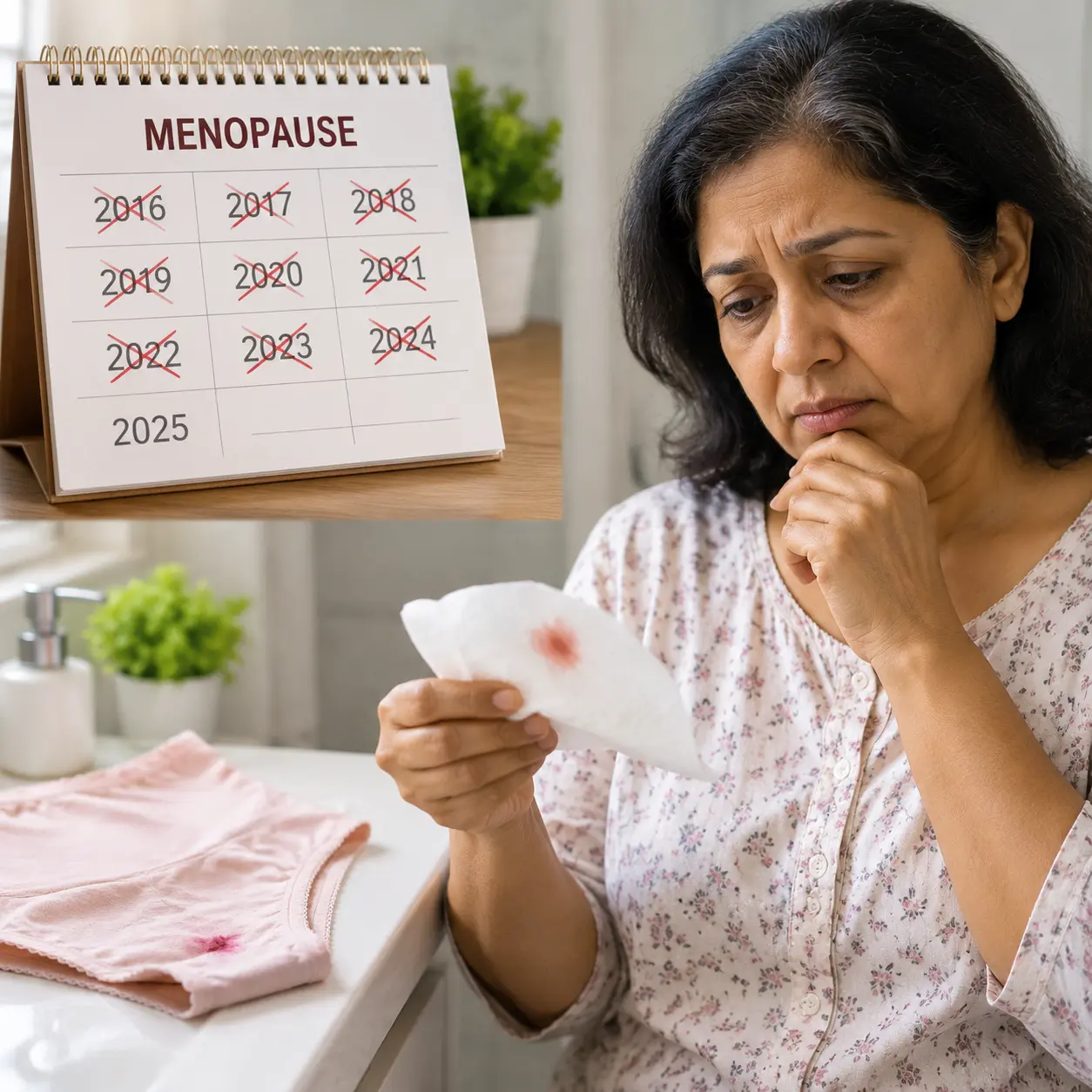
Yes. It needs a check. Even if it was one spot. Even if it was brown, not red. Even if it stopped on its own.
Endometrial cancer starts in the endometrium, the inner lining of the uterus (womb). Once periods stop for good, this lining should stay thin and quiet. After menopause, it should not bleed at all.
A large review of research published in 2018, covering more than 40,000 women, found two things I want every family to know:
- About 9 in 10 women with endometrial cancer had bleeding before they were diagnosed.
- About 9 in 100 women who went to a doctor for bleeding after menopause had cancer.
Read that second line again. Most women with this bleeding do not have cancer. Often the cause is simple, like a polyp (a small growth that is not cancer) or a thin, dry lining.
Think of it like the smoke alarm in your kitchen. When it rings, it is usually due to the tadka, not a fire.
So the real question is not “Is it cancer?” It is “Has someone checked where this blood is coming from?”
But bleeding is not the only sign. What else should you watch for?
What Are the Warning Signs of Endometrial Cancer Besides Bleeding?
The other endometrial cancer symptoms are quieter. They often show up later.
- A watery, pinkish or brownish discharge, even with no blood you can see
- A heavy or dull feeling low in the tummy, between the hip bones
Many women first treat the discharge as an infection. None of these signs alone mean cancer. But if any of them lasts more than two weeks, especially with discharge or spotting, I want to see you.
Now, what if you are still getting periods?
I Haven't Reached Menopause Yet. Should I Still Worry?
Most endometrial cancers are found after menopause. But younger women can get it too.
Before menopause, the signs are about change:
- Bleeding or spotting between periods
- Periods that are much heavier than usual for you
In your forties, there is a common trap. Periods become irregular, and everyone says, “Menopause is coming; this is normal.” Sometimes it is. But irregular periods and heavy bleeding with clots every two weeks are not the same thing.
Your periods have a pattern, like your handwriting. You know it better than anyone.
Some women carry a higher chance than others. Who are they, and why?
Why Does It Happen, and Who Is at Higher Risk?
The lining of the uterus grows under a hormone called oestrogen. Another hormone, progesterone, keeps that growth in check.
Picture a garden that gets water every day, but no one ever trims it. It grows thick and wild. When the lining gets oestrogen without enough progesterone for years, it can thicken in the same way. Over time, some cells can turn abnormal.
Your chance is higher if you:
- Are overweight, especially after menopause. Body fat makes extra oestrogen.
- Have diabetes, or PCOS (a hormone condition that causes irregular periods)
- Take tamoxifen, a breast cancer medicine. The risk is small. Please do not stop it on your own. Just tell your gynaecologist you are on it, and report any bleeding.
- Have never been pregnant
- Have an inherited condition when cancer runs in families
Having these does not mean you will get cancer. And some women who get it have none of them. The list is not for fear. It is for noticing sooner.
"But My Pap Test Was Normal, Doctor"
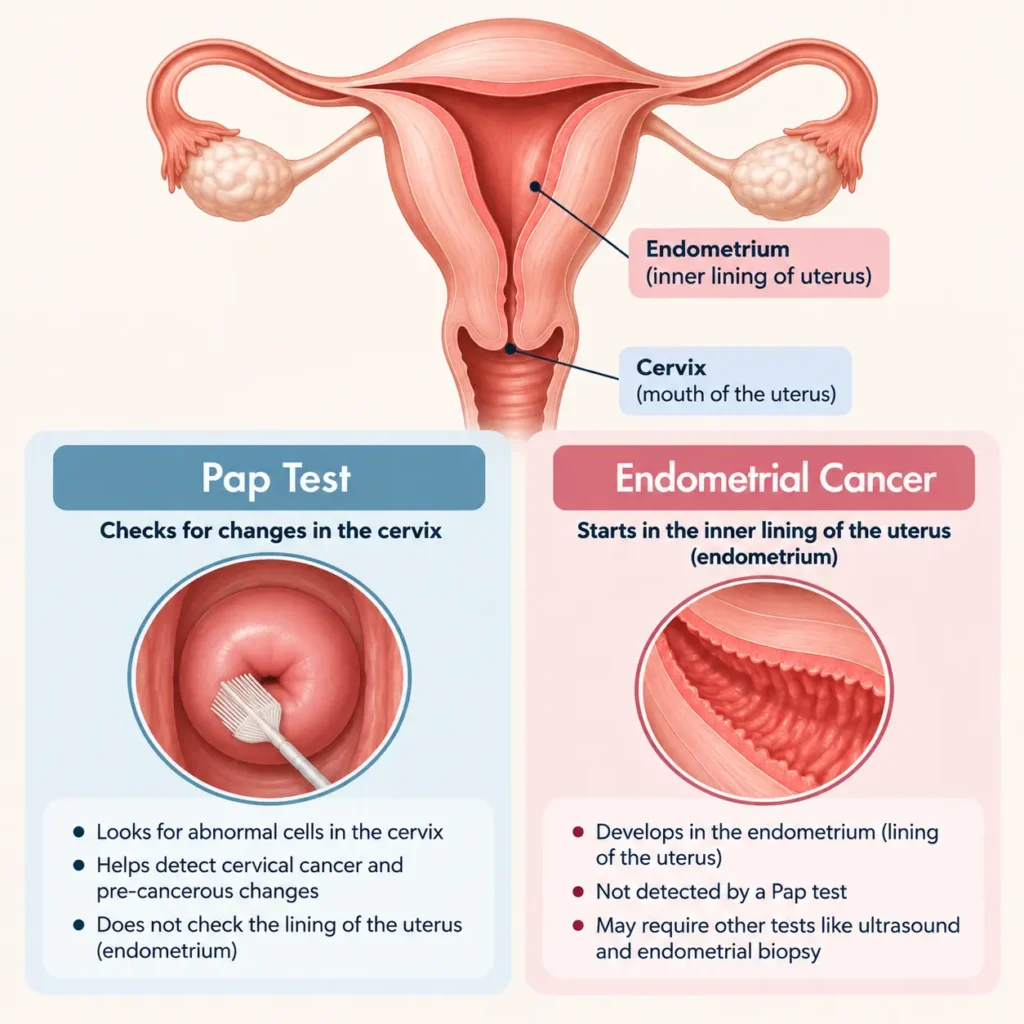
Many women say this with relief. I understand why.
A Pap test checks the cervix, the mouth of the uterus. Endometrial cancer grows higher up, in the inner lining. The American Cancer Society says a Pap test is not a good test for finding endometrial cancer.
So a normal Pap report is good news about the cervix. It says very little about the lining. For a clearer understandingof what Pap test results actually indicate, read “What Does an Abnormal Pap Smear Really Mean?”
There is also no routine screening test for endometrial cancer in women without symptoms. That is why your body’s signal matters so much. For this cancer, the bleeding is the screening test.
So what do I actually do when you walk in with this problem?
What Happens When You Come to Me With Bleeding?
First, I listen. I want to know:
- When did
Then a gentle examination, usually followed by a transvaginal ultrasound. This scan measures how thick the lining is.
But the scan has a limit. It cannot tell me if cancer is present. It only shows whether the lining looks thin or thick. Think of looking at a wall from outside. You can see if the plaster is bulging. You cannot know what is inside until you take a small sample.
That sample is an endometrial biopsy. A thin tube takes a tiny piece of the lining. Sometimes I prefer a hysteroscopy, where a thin camera lets me look inside the uterus and take the sample from the exact spot.
If the bleeding keeps coming back, I will ask for a biopsy even when the scan looks normal. International guidelines say the same. I’m not simply asking “Is the lining thick?” I’m asking, “Why is this woman still bleeding?”
If the biopsy is normal, we treat the real cause, and you go home lighter. If it shows cancer, finding it early changes a lot. In US cancer data, about 95 in 100 women whose endometrial cancer had not spread beyond where it started were alive five years later.
it start, and how much? - Red, brown, or watery?
- Any tablets, including hormone tablets or tamoxifen?
- Diabetes, blood pressure, recent weight change?
- Anyone in the family with uterus, ovary or bowel cancer?
When Can You Book a Visit, and When Should You Rush?
Book a check-up soon (do not wait for “next month”) if:
- You had any spotting or brown discharge after menopause, even once
- Your periods have become much heavier, or come between cycles
- A watery or pinkish discharge keeps coming back
- You are on tamoxifen and notice any bleeding
Go to a hospital the same day if:
- Bleeding is heavy, soaking through pads very quickly, or you pass large clots
- You feel dizzy, faint or breathless
- You have severe pain in the tummy
- Bleeding comes with a high fever
On hormone therapy, some planned bleeding can be expected. Anything outside the pattern your doctor explained needs a call.
For the Daughter or Husband Reading This
Often the woman herself says nothing. Many women simply never knew that bleeding after menopause needed a check. She may mention it to a sister-in-law, who says ଟିକେ ଦାଗ, କିଛି ନୁହେଁ (It’s just a small stain, it’s nothing). Or a local doctor gives tablets, the bleeding stops, and everyone relaxes.
Bleeding that stopped is not a cause that was found.
It is like a warning light on the car dashboard that switches off by itself on the drive from Bhubaneswar to Puri. Good. But you still get the car checked when you reach.
If you are the daughter, don’t argue about cancer. Just say, “Let’s get it checked once, so we can both stop worrying.” Offer to go along.
Questions Women Often Ask Me
Yes. Bleeding from the lining can come and go. A single bleed after menopause still needs a check. Bleeding that returns needs a biopsy, even if an earlier scan was normal.
Often, yes. Because bleeding shows up early, many women are diagnosed while the cancer is still inside the uterus. At that stage, treatment works well for most women.
Yes, though it is less common. Women with PCOS, obesity, or Lynch syndrome in the family carry a higher risk.
When women ask me what are the warning signs of endometrial cancer, I tell them to trust the small ones. After menopause, your body does not send many signals. When it does, listen.
The bleeding may be small. The decision to get it checked is not.
If you or your mother are noticing any of these signs, you can book a consultation with me, Dr. Ushashree Das, Gynecologic Onco-Surgeon.