


Ovarian Cancer Stages 1–4, Part 1: What Does Your Stage Actually Mean?
Quick Summary
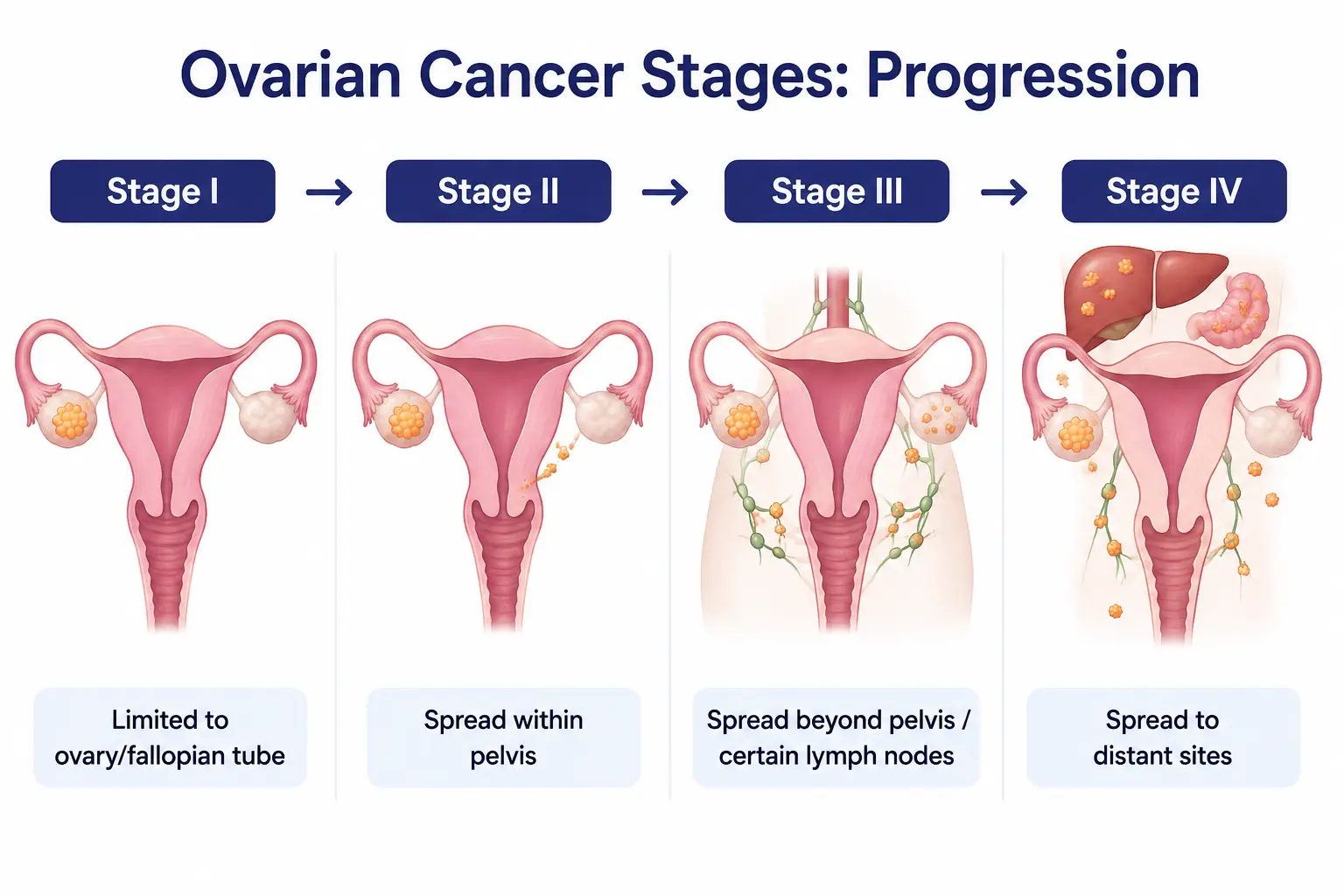
- Stage I: Cancer is limited to one or both ovaries or fallopian tubes.
- Stage II: Cancer has spread to other structures within the pelvis.
- Stage III: Cancer has spread beyond the pelvis into the abdomen and/or certain lymph nodes.
- Stage IV: Cancer has spread to distant sites.
- Ovarian cancer staging is based on the spread of cancer, not on tumour size.
- The final stage often becomes clearer after surgery and pathology, when doctors have more information.
- A higher stage does not automatically determine an individual’s prognosis — the type of cancer, the patient’s overall health, and response to treatment all matter.
Once you hear a stage attached to the diagnosis — Stage I, II, III, or IV — it’s natural to wonder, “How serious is it?” or “What happens next?”
Understanding ovarian cancer and its stages can make the diagnosis a little easier to navigate.
In simple terms, staging describes how far the cancer has spread. Ovarian cancer is generally classified from Stage I to Stage IV.
What Does Staging Mean in Ovarian Cancer?
How Do Doctors Determine the Stages of Ovarian Cancer?
From my experience treating women with ovarian cancer, one of the most common sources of confusion is assuming that a scan alone gives the complete stage. I often have to explain that all imaging methods, CT or PET, have a limitation in detecting disease larger than 6–8mm.
The final stage in ovarian cancer is always determined after we do surgery and remove all organs at risk of being involved, examining them under a microscope, which can detect tumour spread less than 2mm. This gives us a much clearer understanding of the disease and helps us plan treatment appropriately. But in certain scenarios, we have to rely on scans to assign an approximate stage and start chemotherapy before we can proceed with surgery.
Treatment decisions depend on several factors, including the exact pattern of disease, pathology, overall health, and whether surgery and other treatments are appropriate.
From my clinical perspective, I find it important to separate the word “advanced” from the idea that nothing can be done. An advanced stage means the treatment needs to be more nuanced; it does not mean there is no hope of recovery.
Key questions include how much disease is present, where it is located, and which treatment approach is most appropriate.
Can Ovarian Cancer Staging Change After Surgery?
Yes, sometimes.
The information available before surgery may not provide the complete picture. Surgical findings and pathology can reveal additional disease that wasn’t clear on imaging, this doesn’t necessarily mean the earlier scan was wrong.
I encourage patients to bring their imaging, pathology reports, and previous medical records to their consultations. Looking at these findings together gives a much clearer picture than trying to interpret one report in isolation.
Does Ovarian Cancer Get More Serious at Higher Stages?
A higher stage generally means the cancer has spread farther. However, stage alone cannot predict exactly what will happen to an individual patient.
Doctors also consider:
- The type and characteristics of the cancer
- How much disease is present
- Where the cancer has spread
- Overall health
- Treatment options
- How the cancer responds to treatment
This matters especially when looking at survival statistics online. Statistics describe groups of patients — they don’t apply to one particular patient. They’re useful in an academic setting or for clinical decision-making, but they can’t predict what will happen to one individual, because she might be in that rare, lucky 15% of patients, even in the gravest of situations.
Instead of asking only, “What is the survival rate for Stage III ovarian cancer?”, a more useful question may be:
“What does this stage mean in my particular case?”
That allows your doctor to explain the diagnosis in the context of your pathology and disease pattern.
In Part 2, we look at what your stage does not tell you — including a common myth about tumour size — and the exact questions to bring to your gynaecological oncologist.
Ovarian Cancer Stages, Part 2: What Your Stage Doesn't Tell You and What to Ask Next
This is Part 2 of a two-part series. In Part 1, we covered what staging means and how it’s determined. Here, we look at a common misconception, and the exact questions to bring to your gynaecological oncologist.
The entire appointment usually takes 10-15 minutes.
Does Tumour Size Determine Ovarian Cancer Stage?
No. Tumour size alone does not determine ovarian cancer stage.
A smaller ovarian mass does not automatically mean early-stage cancer, just as a larger mass does not automatically mean Stage III or Stage IV. In fact, many times the opposite is true: big ovarian tumours occupying the entire abdomen are not dangerous, while small 2- 3 cm tumours rapidly spread all over the abdomen.
Doctors look at whether the cancer has spread to other organs.
This is why you should not panic simply by looking at the size of an ovarian mass on an ultrasound or CT scan.
Does Stage III or Stage IV Mean Treatment Is Pointless?
No.
An advanced stage changes the treatment discussion, but it does not automatically mean treatment is no longer useful.
The treatment plan depends on the individual disease, pathology, overall health, surgical considerations and other clinical factors.
If you or someone you love has recently been diagnosed, try to move the conversation from:
“Is this hopeless?”
to:
“What exactly has been found, what are the goals of treatment and what happens next?”
These questions can help you understand the situation based on the actual medical findings rather than fear or assumptions.
What Findings Do Not Tell You the Ovarian Cancer Stage?
What Should You Ask Your Gynaecological Oncologist?
It is easy to forget questions during a cancer consultation, so consider writing them down beforehand. Asking the right questions about your ovarian cancer diagnosis can help you understand your treatment options and what comes next.
You may want to ask:
- What is my exact FIGO stage and substage?
- Where has the cancer spread?
- Is the stage confirmed?
- What does my pathology report show?
- What are the goals of treatment?
- Do I need any additional tests before treatment begins?
Taking your imaging, pathology reports, and previous medical records to the appointment can also help your doctor review the entire picture.
What Is the Most Important Thing to Remember About Ovarian Cancer Stages?
If you have just been told your ovarian cancer stage, you do not need to understand everything at once.
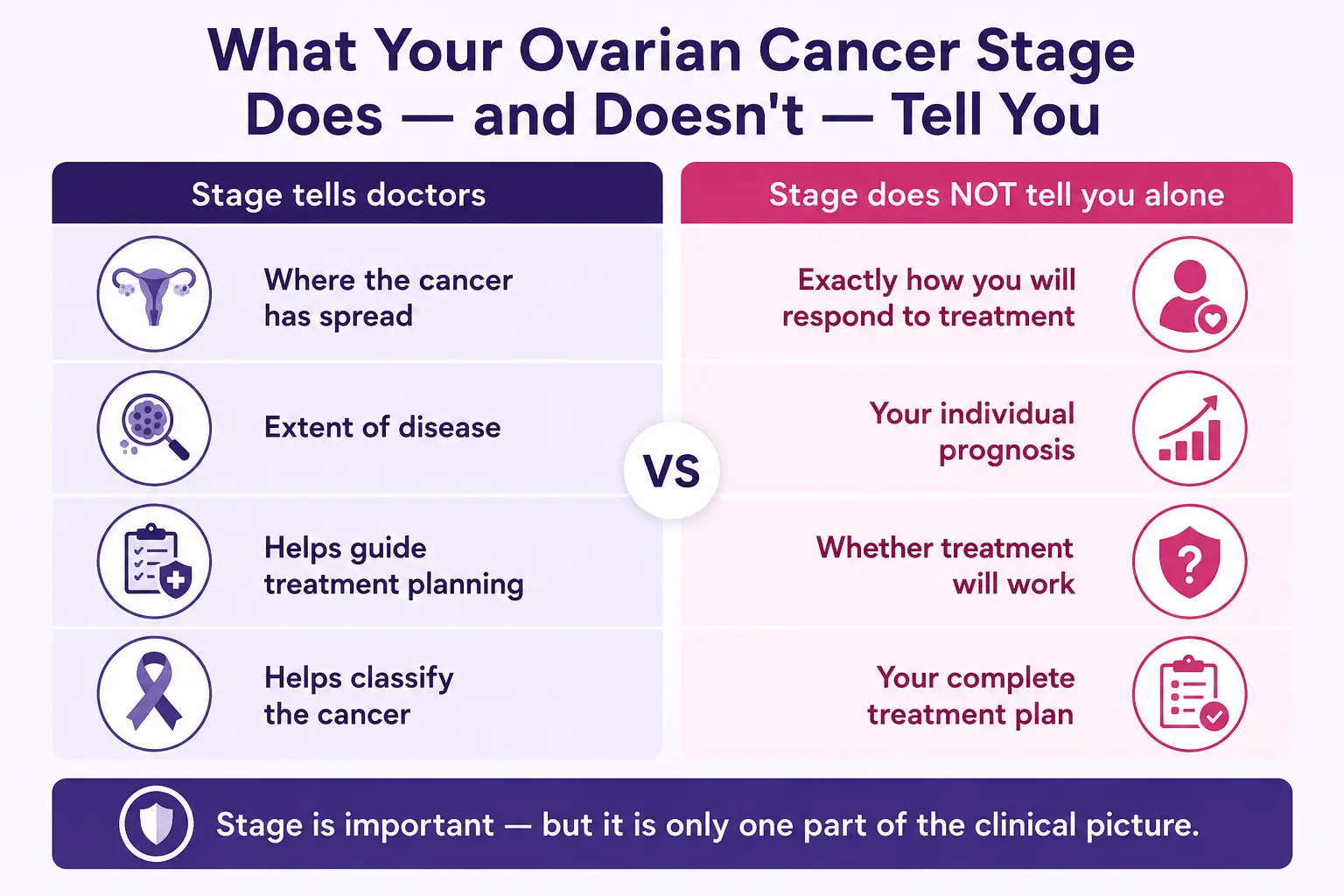
The stage is important, but it is not a complete prediction of your future.
It tells doctors about the extent of the disease and helps guide treatment planning. Your pathology, disease distribution, overall health and response to treatment also matter.
If something in your report does not make sense, you must ask the gynaecological oncologist to explain it in plain language. If two reports appear to say different things, take both to your specialist rather than trying to interpret them separately.
At the end of your consultation, focus on three questions:
Where is the cancer?
What does the staging information tell us?
What happens next?
These questions can help turn an overwhelming diagnosis into a clearer understanding of what comes next.