


What Is the Most Common Reason for Bleeding After Menopause?

Medically reviewed by Dr. Ushashree Das
MCh in Gynaecological Oncology | 10+ years of Experience
Reg. No. 15458/04
Table of Contents
Quick Answer
The most common reason for bleeding after menopause is thinning of the lining of the uterus. Low levels of female hormones cause it. Polyps and a thick lining are also common causes. About 1 in 10 women with this bleeding have uterine cancer. So any bleeding, even one spot, needs a doctor’s opinion soon.
Is This My Period Coming Back?
No. Menopause means 12 months with no period. After that, periods do not restart. Any blood from the vagina after that point is called postmenopausal bleeding. It can be a spot, a brown stain, pink water or red blood. All of it counts.
Many women tell themselves a story. “Doctor, it was only a little. Maybe my body is adjusting?” Your body does not adjust by bleeding after menopause. Even a little blood needs a reason.
So what is that reason?
So What Is the Most Common Reason for Bleeding After Menopause?
Thinning of the lining. Doctors call it atrophy. It only means the tissue has become thin.
Before menopause, estrogen keeps the lining of the vagina and the womb thick, soft and moist. After menopause, estrogen falls. The lining turns thin, dry and fragile.
Think of a cotton saree that has been washed hundreds of times. The cloth is still there. But it is so thin that one small tug tears it. A thin lining behaves the same way. A little rubbing, or even nothing, and it bleeds. It can happen in the vagina, in the womb lining, or in both.
The treatment is often simple. Some women need none. Others are offered estrogen cream or pessaries, which are small tablets placed in the vagina.
Now, the honest limit. I can call it thinning only after I have ruled out the other causes. I reach that diagnosis by checking, not by guessing. And that brings us to the other causes.
What Else Can Cause Bleeding After Menopause?
Several things can. Most of them are not cancer.
- Polyps. These are soft growths on the lining of the womb or on the cervix, the mouth of the womb. Think of a small skin tag, but inside the body. Most are not cancer. Some bleed, and a specialist may need to remove them.
- A thickened womb lining. Doctors call it hyperplasia. It happens when estrogen keeps building the lining, and nothing balances it. Hormone medicine, high estrogen levels and being overweight can all cause it. Picture a wall that gets a fresh coat of paint every Diwali, without scraping off the old coat. Some types can lead to womb cancer, so I take this one seriously.
- Hormone medicine (HRT). Spotting is common in the first 4 to 6 months after starting it. Even then, tell your doctor. If the bleeding goes on, or starts later, it needs a check.
- Infection. An infection of the vagina or cervix can also cause bleeding.
- Cancer. Less often, the blood comes from cancer of the womb, cervix, ovary or vagina.
That last word is the one on your mind. So let us talk about it.
Doctor, Is It Cancer?
Usually, no. But sometimes, yes.
A large review of 129 studies, led by researchers at the US National Cancer Institute, looked at this—about 9 in 100 women with bleeding after menopause had womb cancer. So about 91 in 100 did not. The same review found something else. About 9 in 10 women with womb cancer had this kind of bleeding.
Read those two numbers together. Bleeding is the body’s smoke alarm. Most of the time, it’s only toast burning. But you still walk into the kitchen to check. You do not switch off the alarm and go back to sleep.
I must also be honest about what I cannot tell you from a distance. I cannot tell the cause from the colour, the amount, or whether it hurts. Heavy red bleeding can be harmless. A little brown spotting can be serious. Only a check can tell.
So the real question is not “Is it cancer?” The real question is “What is the cause?” Cancer of the womb may be easier to treat when it is found early. That’s why it’s important to act fast.
What If It Was Only One Spot, or Just Brown?
It still counts. Pink, brown or red, one spot or a full pad, all of it needs a check. Spotting after sex counts too.
And if it stops on its own, the cause hasn’t gone away. It may only be waiting.
Many women wait for a second spot before they act. Please do not. One episode is reason enough to start the check.
What Happens When You Come for a Check?
I am not asking only “Is there cancer?” I am asking where the blood is coming from, and why. I do that in small steps.
- I listen. When did it start? How much was it? Is there pain? Which medicines do you take, including HRT?
- I examine you. I look at the vagina and cervix with a speculum, the same small instrument used for a Pap test. I also check the pelvis with my hands.
- I do a vaginal ultrasound. A thin probe goes into the vagina, and the scan shows the womb. I measure the thickness of the womb lining.
- If I need to look closer, I take a small sample of the lining, called a biopsy. Sometimes I use a hysteroscopy, a thin camera passed through the cervix into the womb. It can be done under local or general anaesthesia.
Why measure the lining? The American College of Obstetricians and Gynecologists says a lining of 4 mm or less has a greater than 99% chance of not being womb cancer. For a first episode of bleeding, a thin lining like this can often be enough to stop there.
A lining thicker than 4 mm does not mean cancer. It means I need to look closer. Think of the ultrasound as a drone view of a road. It shows where the road looks wrong. The biopsy is like walking down and touching the surface to see what it is made of.
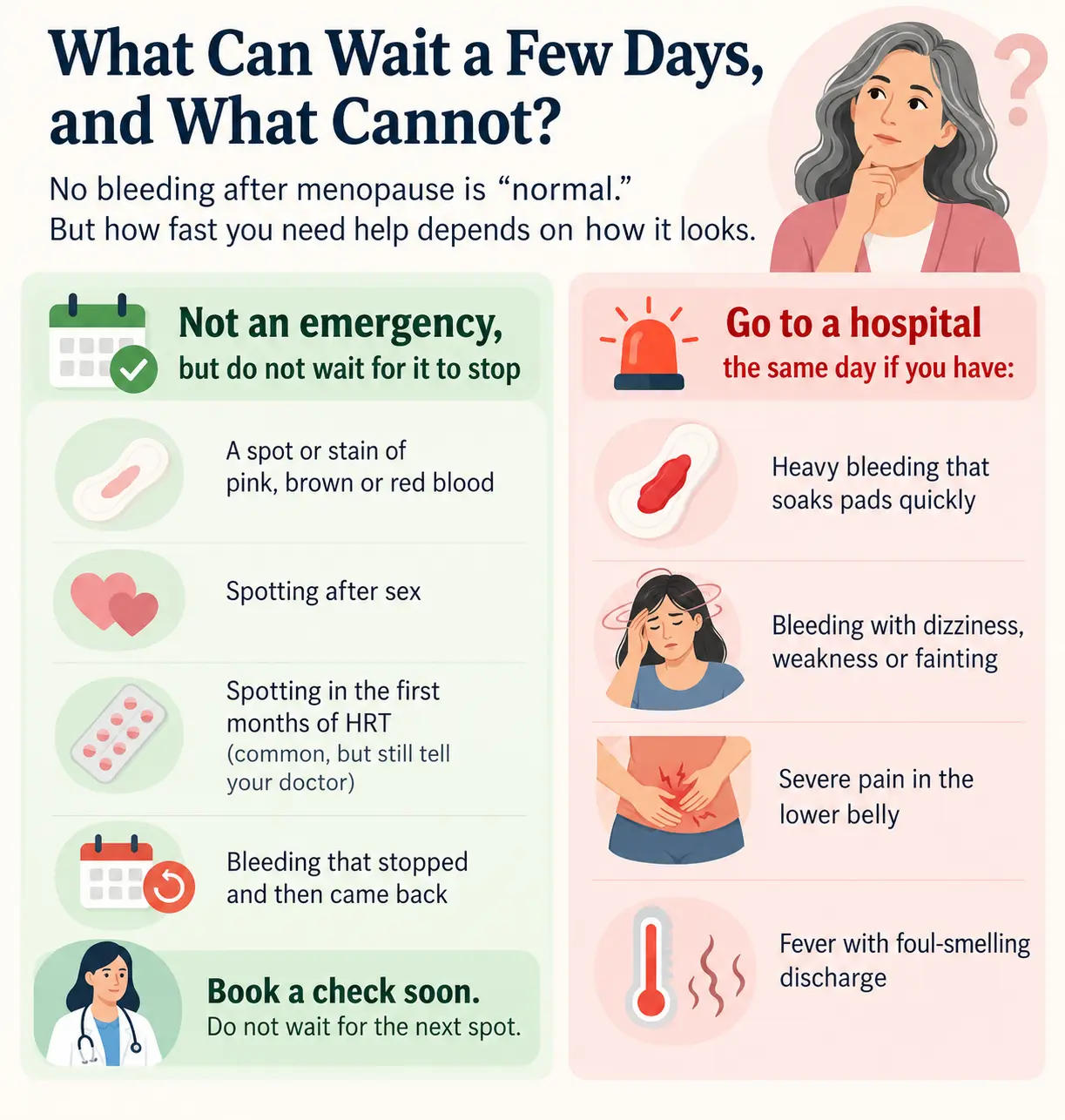
What Can Wait a Few Days, and What Cannot?
A Word for the Family
If your mother, wife or aunt mentions “a little blood,” please do not say, “At this age these things happen.” Say, “Let us go to the doctor together.”
Many women stay silent out of shame, or because they do not want to worry the family. Your support may be what gets her to the clinic. Go with her. Ask the questions. Carry the reports.
Frequently Asked Questions
It is common in the first 4 to 6 months. Still tell your doctor. If the bleeding continues after that, or starts later, you should get checked. Please do not stop the medicine on your own.
A gynecologist is a good first step. If tests show cancer or a pre-cancerous change, a gynecologic oncologist plans the treatment. This is a surgeon trained in cancers of the female organs.
Please Do Not Sit on This
The short version: If you have had bleeding after menopause, please come and see me at Bagchi Sri Shankara Cancer Centre, Bhubaneswar. Bring any scan or test reports you already have.
This article is for general information. It does not replace a consultation with a doctor. Please do not start, stop or change any medicine without your doctor’s advice.