



Stage 4 Ovarian Cancer: What It Means, Symptoms, Treatment and Survival Rate
Table of Contents
Key Takeaways
- Stage 4 ovarian cancer is advanced cancer, but it does not mean that treatment is no longer possible.
- Symptoms alone cannot tell us whether the cancer is early stage or advanced. Clinical examination, scans, and pathology are also important.
- Treatment may include chemotherapy, surgery, targeted treatment, or a combination, depending on the individual case.
- There is no single ovarian cancer stage 4 survival rate that applies to every patient. Tumour type, spread, overall health, and response to treatment all matter.
- Survival statistics describe large groups of people, not an individual patient’s future. They should not be treated as a countdown.
- Patients and families should discuss the extent of spread, treatment goal, surgery, chemotherapy, genetic testing, expected side effects, and warning symptoms with their oncology team.
- Do not make treatment decisions based only on survival statistics, online stories, or advice from relatives. Base your treatment decisions on your individual disease and health.
“Doctor…they have told us it is stage 4 ovarian cancer. Does this mean there is no hope?”
Patients and families ask this after hearing the words “stage 4 ovarian cancer“.
And I understand why.
The word “stage 4” can feel like a final answer. Educated family members and sometimes patients themselves start searching for survival rates. Someone may tell them about a relative who had the same diagnosis and had some bad reaction to chemotherapy. Another person may say, “naturopathy works better at this stage.”
Please pause before believing any of these statements.
Stage 4 ovarian cancer is advanced cancer, but the stage alone does not tell us what will happen to one particular woman.
There are important questions we need to answer first.
Where has the cancer spread? What type of ovarian cancer is it? How is the patient’s general health? How is she likely to respond to treatment?
These details matter.
So, if you or someone in your family has recently been diagnosed, let’s take this one step at a time.
First, What Does Stage 4 Ovarian Cancer Really Mean?
When ovarian cancer is called stage 4, it means the cancer has spread beyond the abdomen to distant parts of the body.
Stage 4 is further divided into stage IVA and stage IVB.
In stage IVA, cancer cells may be found in fluid around the lungs. In stage IVB, the cancer has spread to organs or tissues outside the abdomen, such as distant lymph nodes or other organs.
This tells us about the extent of the cancer.
Think of staging like looking at a map.
The map tells us where the disease has reached. But it does not tell us exactly how the journey will go.
That is why I do not like to look at the stage alone.
I want to understand the whole patient.
Does Stage 4 Ovarian Cancer Mean There Is No Treatment?
No.
Stage 4 ovarian cancer is advanced and needs serious treatment planning. But treatment exists. The aim may be to control the cancer, reduce the amount of disease, relieve symptoms, improve quality of life, and, in some patients, achieve a long period without active disease.
The treatment plan depends on several things, including:
- The exact type of ovarian cancer
- Where the cancer has spread
- The amount and location of the disease
- Whether surgery can safely remove most or all visible disease
- The patient’s age and general health
- Other medical conditions
- Molecular or genetic findings when relevant
- How the cancer responds to treatment
For many patients with advanced ovarian cancer, treatment may involve chemotherapy and surgery, sometimes with targeted treatments or other therapies depending on the individual case.
There is no single treatment plan that is right for every woman.
That is why comparing your treatment with a neighbour, relative, or something you read online can be misleading.
What Are the Symptoms of Stage 4 Ovarian Cancer?
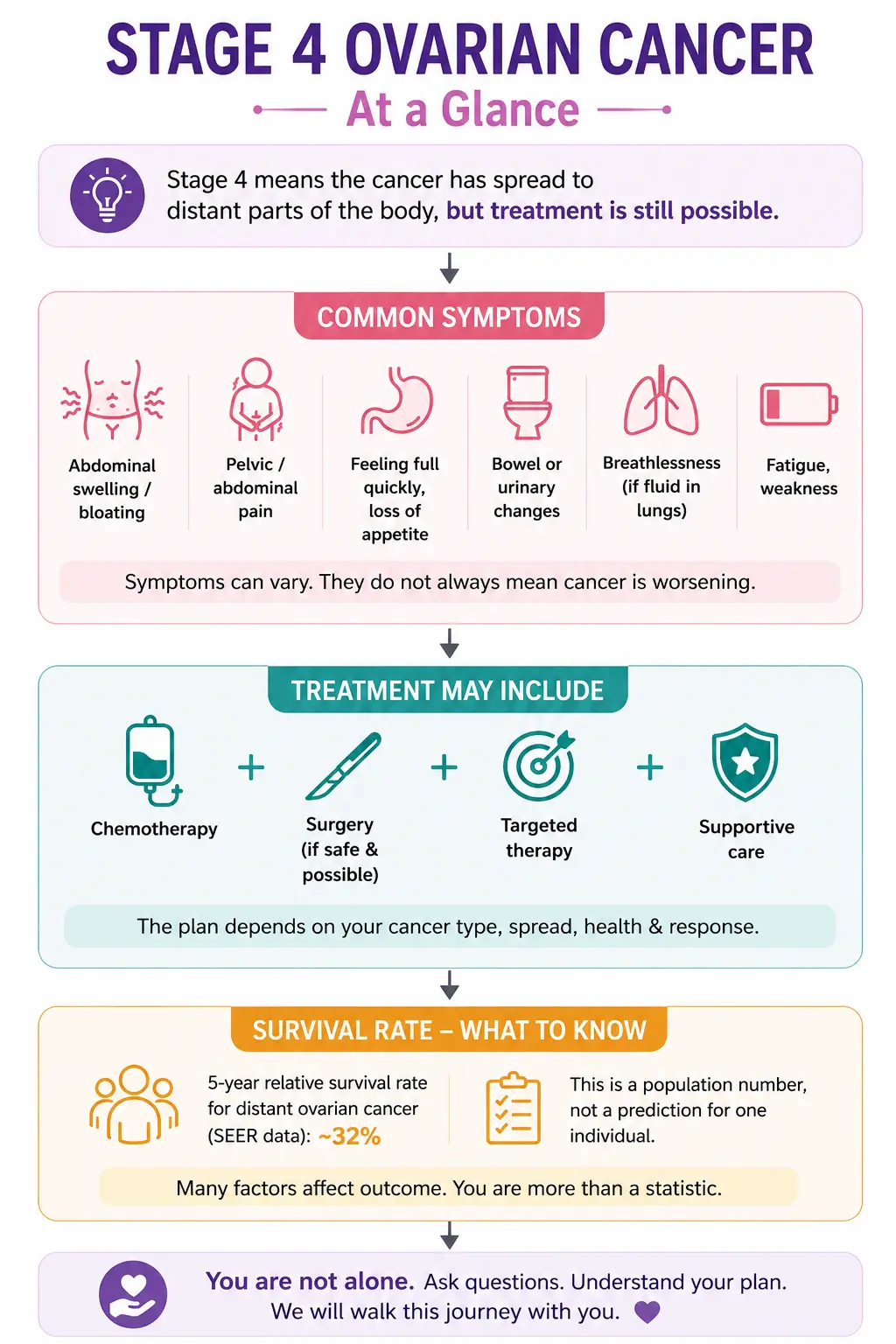
The stage 4 ovarian cancer symptoms can vary greatly from one person to another.
Some women may have several symptoms. Others may have surprisingly few symptoms despite having advanced disease.
The symptoms are not specific to ovarian cancer. Bloating, constipation, abdominal discomfort, or urinary problems can happen with many other conditions too. Initially, these symptoms might seem minimal to you, but it is necessary to consider them and make a note of early ovarian cancer symptoms.
When Should a New Symptom Worry You?
This is especially important after treatment has started. Not every change means that the cancer is progressing.
Feeling tired after chemotherapy is common.
Nausea can happen after treatment.
Appetite can change.
Bowel habits may change.
Still, discuss these symptoms with the treating team if they persist or are severe. But they should not automatically make you think, “The cancer has spread more.”
At the same time, you should not ignore some symptoms.
Seek prompt medical advice if there is:
- New or worsening breathlessness
- Persistent vomiting or inability to keep fluids down
- Significant abdominal swelling with increasing discomfort
- Sudden or marked weakness
- Confusion
- A rapid deterioration in daily activities
- Persistent bleeding or another unusual new symptom
- A symptom that appears suddenly or becomes much worse over a short period
When in doubt, it is better to ask the treating team than to spend the night searching online.
What Treatment Is Usually Considered for Stage 4 Ovarian Cancer?
The treatment of ovarian cancer depends on the individual patient.
In many women with advanced epithelial ovarian cancer, treatment may involve a combination of systemic therapy and surgery. Chemotherapy is commonly used because ovarian cancer may involve several areas of the abdomen or distant sites.
What Is the Ovarian Cancer Stage 4 Survival Rate?
This is usually the question patients are most afraid to ask.
“Doctor, how much time does she have?”
I understand why you want to know.
But there is no single number that can tell us exactly how long one person with stage 4 ovarian cancer will live.
Doctors do have survival statistics. These numbers come from following a large number of patients over several years.
For ovarian cancer that has spread to distant parts of the body, about 31–32 out of every 100 women are alive five years after diagnosis, based on recent U.S. data. (SEER)
But please don’t look at this number and think:
“My survival is 32%.”
That is not what the number means.
It is an average from a large group of women. Some women live for much longer. Some may not live as long.
Your situation can be very different from someone else’s.
Why Is It Different for Every Woman?
Ovarian cancer is not exactly the same in every patient.
We look at things such as:
- What type of ovarian cancer you have
- Where the cancer has spread
- How much cancer can be removed with treatment
- How well the cancer responds to chemotherapy or other medicines
- Your age and overall health
These details help us understand your individual situation.
Does the Survival Rate Tell You How Long Someone Will Live?
No.
A survival rate is a population statistic.
It is not a countdown clock.
If you read that the 5-year relative survival rate is 32%, it does not mean that a particular patient has 32% odds of living five years. Nor does it mean that the remaining time is limited to a particular number of months or years.
Age, overall health, tumour type, extent of disease, treatment received, response to treatment, and other factors can all affect the outlook. The American Cancer Society also points out that people being diagnosed today may have better outcomes than older statistics suggest because treatments continue to improve.
So when a family asks me, “Doctor, what is the survival rate?” I also want to know what they really mean.
Often, they are asking:
“How much time do we have?”
You can’t get that answer from a website percentage. Actually, no one can, and no one should give such unnecessary predictions before starting any treatment.
What Should You Ask Your Oncologist After a Stage 4 Diagnosis?
If you are sitting in the consultation room and your mind has gone blank, that is completely understandable.
Cancer consultations can be overwhelming.
Take a notebook. Keep the reports together. If possible, have one family member with you. Here are some questions to ask when diagnosed with ovarian cancer.
Ask:
- Where exactly has the cancer spread?
- What type of ovarian cancer is it?
- Is it stage IVA or IVB?
- What is the goal of treatment?
- Do you recommend chemotherapy before surgery or surgery first?
- Should genetic or molecular testing be done?
- How will we know whether treatment is working?
- What side effects should we expect?
- Which symptoms require urgent medical attention?
- When will we reassess the treatment plan?
These questions are often more useful than spending hours comparing survival stories online.
What If Your Family Is Giving You Different Opinions?
This happens often.
One relative may say, “Get surgery immediately.”
Another may say, “Don’t do chemotherapy.”
Someone else may send a video promising a miracle treatment.
And the patient is left thinking, “Whom should I listen to?”
Please remember that every patient’s story is different.
Your relative’s treatment may have been right for them. It does not automatically make it right for you.
Bring those questions to your gynecologic oncologist or oncology team.
You do not have to understand every medical term before making a decision.
Your doctor should explain why a particular treatment is being recommended, what benefit is expected, what the risks are, and what alternatives exist.
The decision should be based on your disease and your goals, not on fear or pressure from the people around you.
Frequently Asked Questions
Stage 4 ovarian cancer is advanced cancer, and treatment can be complex. Whether a patient can achieve long-term remission depends on several individual factors. It is not accurate to say that every stage 4 case is either curable or incurable without knowing the patient’s disease and treatment response.
For chemotherapy, there is no specific dose that we must give to get a response. We adjust the dose based on the patient’s overall condition and whether she can tolerate the chemotherapy.
Yes. Ovarian cancer can recur after treatment. If it does, the treatment approach depends on where the cancer has returned, previous treatments, how long it has been since treatment, and the patient’s overall health.
Yes and No.
Yes, in thinking that if one person has a good result, then that is possible for me too.
No, because in the age of social media, people are quick to spread false news for their own personal benefit. I would request that you apply proper judgement and investigate before making any decision to start your cancer treatment.
In ovarian cancer treatment, earlier is better because it is usually a rapidly spreading tumour. But taking 5-7 days to complete all investigations and arrange logistics should be alright.
If you or someone you love has recently been diagnosed with stage 4 ovarian cancer, you do not have to figure everything out from the internet. The most useful information is the information that applies to your particular case. Consult a Gynecological Oncologist for all your queries.